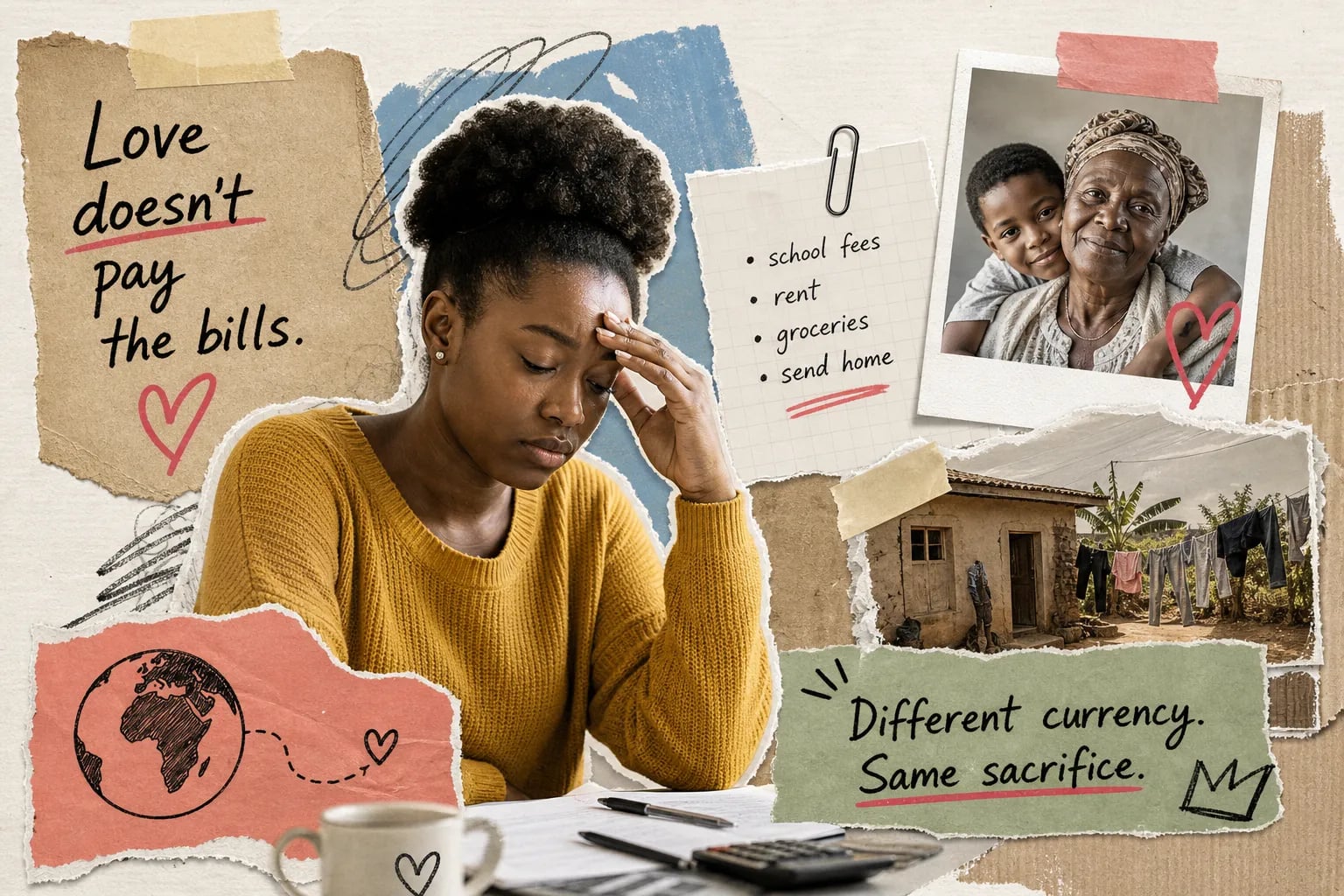
African diaspora family responsibility is not a single obligation. It is a layered system of financial transfers, emotional labor, long-distance caregiving, and cultural transmission that many diaspora members carry without ever naming it out loud. In many communities, the cultural script runs something like this: you left, you made it, you owe the village. What the script leaves out is any guidance on how to give without emptying yourself. This article names the parts of that system, remittances, long-distance caregiving, emotional labor, and cultural transmission, that rarely get discussed openly, and it closes with a practical framework for carrying family obligations without letting them dismantle the life you are building abroad.
What makes this hard is not the values underneath the duty. Those values, collective responsibility, reciprocity, honoring the people who shaped you, are worth preserving. What makes it hard is the absence of structure around them. Unstructured obligation tends to expand until it crowds out everything else. Understanding what you are actually carrying is the first step toward carrying it on purpose.
Key takeaways
- Obligation is culturally rooted: African diaspora family responsibility extends across extended kin networks, not just nuclear households, making diaspora obligations broader than most Western frameworks account for.
- Remittances carry symbolic weight: For many diaspora members, sending money home is both practical support and proof of continued belonging, not simply a financial transaction.
- Women carry a disproportionate share: Research on Nigerian and Ghanaian communities shows women absorbing both financial and emotional caregiving burdens, often simultaneously, across borders.
- Children need both cultures: Bicultural socialization, being supported in both African heritage and American life, is associated with cultural pride and better wellbeing outcomes in research on African-heritage youth.
- Structure is the missing ingredient: A defined giving plan, not less generosity, is what protects both your family relationships and your long-term financial stability.
- Planning tools exist for this: Life design platforms built for the diaspora experience, like Homeward, can hold family obligations and personal milestones in the same roadmap.
Why African diaspora family responsibility means something different
Traditional African family structures distribute responsibility across extended kin networks, not just parents and children. The concept of Ubuntu, common across Southern African societies, frames the idea that an individual’s success belongs in part to everyone who shaped them. Grandparents, aunts, uncles, and community elders all carry weight in a child’s upbringing, and that weight is expected to circle back when the child grows up. In practice, your obligation as a diaspora member is not to two or three people. It is to a network.
Across many African cultural groups, reciprocal obligation is baked into the parent-child relationship from birth. Parents protect, provide, and educate; adult children are commonly expected to honor, support, and eventually care for parents in old age. For diaspora members, the fact of living abroad does not dissolve that expectation. It relocates it.
Research on Nigerian and Ghanaian immigrant communities consistently shows that filial norms remain strong after migration but are reorganized around money transfers, phone calls, and delegated local care rather than co-residence. The obligation survives the ocean. It just changes shape. Understanding that shift, from physical presence to transnational support, is essential to managing family responsibilities in the diaspora without burning out.
Remittances and family support: the symbolic and financial reality
For many diaspora members, remittances are not purely practical. Research on Nigerian immigrants in Canada found that financial transfers functioned both as direct support, covering food, medical bills, and school fees, and as symbolic evidence that the migrant still belonged to the family. Sending money is how you say “I haven’t forgotten you” when you can’t be there in person. That emotional dimension is real, and it matters. It also makes it harder to put a limit on the amount.
What sending money home actually costs you
According to the World Bank Open Knowledge Repository, roughly one-third of African migrant households remit money to family back home. What they don’t capture is the informal cost on top of that number: the emergency wire sent when a parent gets sick, the school fees covered when a sibling falls short, the construction money advanced before a house is finished.
The problem is not the giving. It is the absence of a plan around the giving. Without a defined framework, remittances tend to expand to fill whatever space is available. Requests arrive without warning, amounts escalate during family crises, and diaspora members end up funding emergencies that crowd out their own savings goals, retirement contributions, and long-term plans. Reactive generosity is not generosity with a future.
What caring for aging parents from thousands of miles away actually looks like
A systematic review of transnational elder-care literature identified economic, emotional, identity, and gender-based themes running through diaspora caregiving experiences. Women, in particular, often absorb both the financial obligation and the emotional weight, coordinating care remotely while also managing households and careers in their host country. Research on Nigerian family structures links patriarchal expectations to women’s disproportionate caregiving burden, even across borders.
When co-residence is no longer possible, families reorganize care through a combination of regular money transfers, phone and video check-ins, coordination with siblings or cousins who live near the parents, and in some cases, hired care workers. Technology supplements but does not replace physical presence. The gap between what a video call can offer and what a parent actually needs is where most of the guilt lives.
Transnational caregiving research describes a bidirectional burden that many diaspora members carry: supporting aging relatives abroad while simultaneously raising children, managing mortgages, and building careers in the United States. Neither side of that equation is optional. What is missing, in most cases, is an explicit plan that accounts for both. African American caregivers, according to data reviewed in a 2025 AARP research report on caregiving in the U.S., report more frequent financial consequences including stopping savings, using emergency funds, borrowing money, and taking on debt. The dual-caregiving dynamic amplifies every one of those risks.
Transnational caregiving strategies that actually work
Families who manage long-distance elder care most sustainably tend to do a few things deliberately: they designate a local sibling or cousin as the primary on-the-ground coordinator, they set a predictable monthly transfer amount for routine expenses, and they maintain a separate contingency fund for medical emergencies rather than absorbing those costs reactively. None of these strategies eliminate the emotional weight, but they reduce the financial unpredictability that tends to compound it.
How raising children between two cultures reshapes diasporic parenting
Children of African diaspora families often acculturate faster than their parents. They learn American English, absorb peer norms, and develop expectations around independence, communication, and discipline that can directly conflict with what parents grew up expecting. Qualitative research with Liberian, Ghanaian, Nigerian, and Southern African immigrant families in the U.S., U.K., and Australia consistently identifies this acculturation gap as the primary site of intergenerational conflict. The gap itself is not the problem. How families navigate it determines whether it becomes a rupture or a bridge.
Studies of African-heritage youth in Western countries link the absence of secure cultural identity to anxiety, social isolation, and what researchers call identity uncertainty, not knowing where you belong. Bicultural socialization, however, being supported in both your heritage and the society you live in, was associated with cultural pride and better wellbeing outcomes, according to published research on Black immigrant-origin youth. The protective factor is not choosing one culture but being given a stable place inside both.
Families who navigate this most successfully don’t force children to choose between being African and being American. They build what researchers call a third culture at home through language, food, ritual, and conversation that honors both. Effective approaches identified in the literature include using African languages at home, making heritage practices part of ordinary family life rather than special occasions, teaching family history alongside African history, and maintaining connections to extended family and ethnic community networks. This requires intentional design, not just instinct, especially when both parents are navigating their own acculturation and rebuilding identity at the same time.
How to keep giving to family without losing your own financial footing
One of the most practical frameworks in research on intergenerational family conflict is this: keep the value, reconsider the method, explain the reason, and decide together where circumstances allow. The same logic applies directly to financial giving. The value, caring for family, honoring obligation, maintaining connection, does not have to be surrendered. The method, unlimited, unstructured, reactive giving, can be redesigned.
A sustainable giving plan starts with three decisions. First, how much you can give each month without compromising your own financial stability. Second, what categories of family need you will and will not fund. Third, how you will communicate those limits in culturally appropriate ways. Practical strategies documented in the research include:
- Creating a fixed monthly “family support” budget and communicating it as a ceiling rather than a starting point
- Separating recurring support from emergency requests so each has its own defined pool
- Sharing remittance responsibility across siblings or cousins so no single person becomes the default provider
- Offering direct payment to institutions for large expenses like medical bills or school fees, rather than transferring lump sums
These conversations are not easy. They are significantly easier, though, than rebuilding your finances after years of unplanned giving have derailed your savings, housing, or retirement goals.
Language matters too. Framing limits around sustainability and shared wellbeing, “I want to keep helping over the long term, so I need us to work within this amount”, tends to preserve relationships in ways that abrupt refusals do not. The goal is to be generous by design, not by pressure.
Duty and design can live in the same plan
When you are holding family responsibilities in the diaspora alongside your own financial milestones, the challenge is not motivation, it is structure. Homeward is a life planning platform designed specifically for Africans living abroad. It helps diaspora members map family obligations and personal financial goals side by side in a structured 3-, 6-, and 9-year roadmap, so remittances, caregiving costs, and home-country investments are planned for rather than absorbed as recurring surprises. The platform starts with a “True North” self-assessment that helps you define what a meaningful, rich life actually looks like for you before any timelines or tactics are introduced. That sequence matters: values first, plan second.
If you want a concrete starting point, the free Life Snapshot tool turns your current priorities and responsibilities into three actionable next steps, with no account or payment required. It won’t solve every complexity of transnational family life, but it gives you a structure to begin the conversation with yourself about what you owe, what you need, and how to honor both.
African diaspora family responsibility is real, deeply rooted, and not going away. The communal values that shaped it are worth preserving. What needs to change is the absence of structure around them. When giving is unplanned, it tends to cost more than money, it costs clarity, stability, and sometimes the future you moved abroad to build. The goal is not to give less. It is to give consciously, sustainably, and from within a plan that also honors your own life. That balance is possible. It just requires the kind of deliberate design that Homeward was built to support.
Frequently Asked Questions
Can technology replace being there in person for aging parents?
No, technology supplements but does not replace physical presence. Video and phone check-ins help coordination and emotional connection, but they cannot fully meet the material or hands-on needs that create much of the caregiving burden, which is why families often combine technology with local coordinators or hired care workers.
Who in diaspora families typically absorbs the heaviest caregiving costs and labor?
Women often absorb a disproportionate share of both financial and emotional caregiving burdens. Research on Nigerian and Ghanaian communities shows women coordinating remote care while managing households and careers, and patriarchal expectations can amplify that imbalance across borders.
How can we begin setting a sustainable remittance plan without cutting off support entirely?
Start by deciding a fixed monthly amount you can give without harming your own financial stability, set categories you will and will not fund, and communicate those limits as a ceiling for sustainability. Practical steps include separating routine support from an emergency fund, sharing responsibility across siblings or cousins, and paying institutions directly for large bills rather than sending lump sums.
What is the Life Snapshot tool and do we need to sign up or pay to use it?
The Life Snapshot tool is a free starting point that turns your priorities and responsibilities into three actionable next steps, and it does not require an account or payment. It provides structure to begin conversations about obligations and goals, though it won’t resolve every complexity of transnational family life.
Leave a Reply